Heads up: CrazyCatVid is reader supported. Some links below are affiliate links (Amazon, Litter-Robot, Life's Abundance). If you buy through them I earn a small commission at no extra cost to you. Every product here has been through my own four cats first.
A Bolivian family found a tiny spotted cub on the side of a forest road and did what any of us would do: they took him home and tried to raise him like a house cat.
He ate noodles, rice and eggs. Then he started chasing the chickens, making sounds no house cat makes, and acting very much like the wild animal he was. A decade later, DNA testing proved what nobody expected: he was not a house cat, not an oncilla, and not any cat science had a name for. He was a brand-new species.
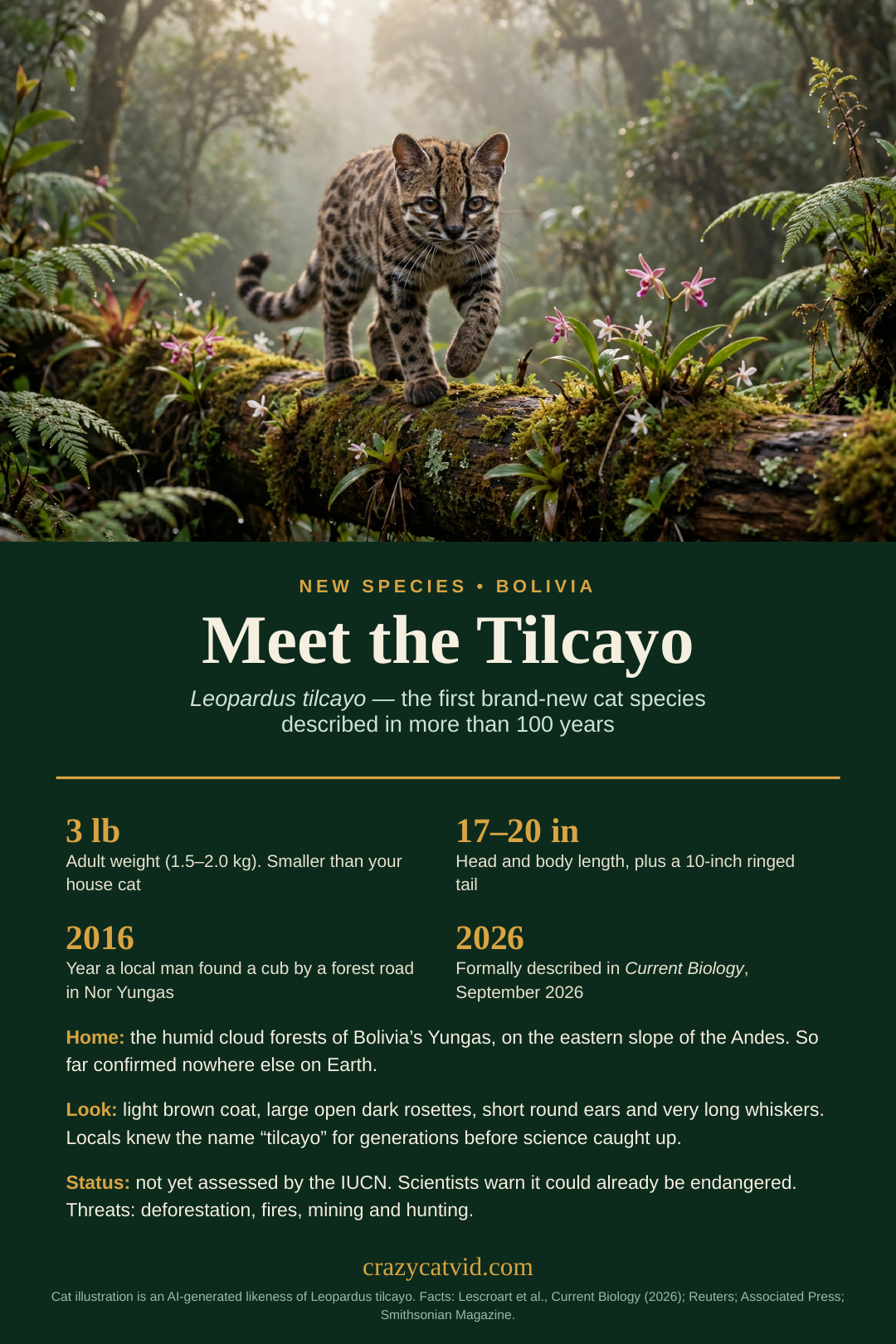
Meet the tilcayo, Leopardus tilcayo, formally described in the journal Current Biology in September 2026. It is the first completely new living cat species described in more than 100 years.
A cub by the road
Around 2016, a local man in Nor Yungas, in Bolivia's La Paz department, found the cub alone on a road in the forest, dirty and in the rain. He kept the little cat for about a year, until the wild behavior made it clear this was no pet. In 2017 the young male was taken to Senda Verde Wildlife Sanctuary, near Coroico, about 100 km from La Paz.
There, volunteer biologist Paola Nogales-Ascarrunz got a call about “a weird cat.” She photographed him and filed him away as an oncilla (Leopardus tigrinus), the small spotted cat the tilcayo most resembles. But something nagged at her. By 2019 she was comparing him against guidebooks: his rosettes were too big, and his face and tail did not match. Maybe he was a southern tiger cat (Leopardus guttulus)? Early genetic tests were inconclusive, and she did not trust them.
So she retrained in genetics, teamed up with Jonas Lescroart and senior author Eduardo Eizirik, and did the DNA work properly. In September 2021 the Senda Verde male was formally sampled. He became the holotype of a new species, specimen CBF-11990. A second tilcayo, a female rescued in 2018 after being stoned and trapped in a tree, was sampled and released, confirming he was not a one-off oddity.
Smaller than your house cat
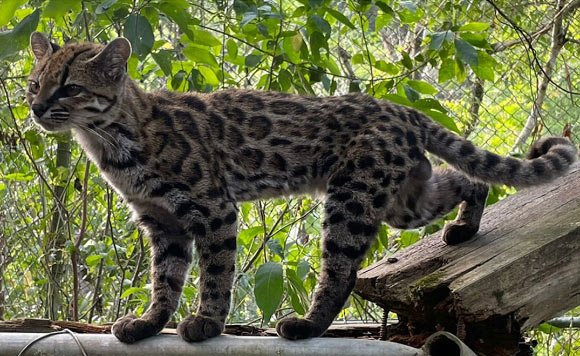
The tilcayo is tiny. Adults measure about 42.5 to 50.5 cm (17 to 20 inches) head and body, with a 25 to 26.5 cm tail, and weigh roughly 1.5 to 2.0 kg (about 3 to 4.5 pounds). The Senda Verde male, nicknamed Tigrino, weighs about 1.4 kg. Your average house cat outweighs him.
His coat is light brown to beige, darker along the back and paler on the legs, covered in large, irregular, dark brown-black rosettes that stay open rather than merging. Compared with his closest relatives, his fur is shorter, his tail is less bushy without broad complete bands, and his face is small and slightly scrunched, with short round ears and strikingly long whiskers.
Three tiger cats became five
The tilcayo did not appear out of nowhere. For centuries, scientists lumped all of South America's little tiger cats into one species, Leopardus tigrinus. In 2013 the southern population was split off as L. guttulus. In 2024, a major study split the group into three: the savanna tiger cat (L. tigrinus), the Atlantic Forest tiger cat (L. guttulus), and the cloud tiger cat (L. pardinoides).
The 2026 study went further, sequencing whole genomes from 38 cats, including museum specimens and the first genetic look at the Guiana Shield population that the name tigrinus actually belongs to. The result: five distinct tiger cat species, including the re-established L. emiliae and the brand-new tilcayo, whose lineage split off roughly 1.4 million years ago. Under the old scheme, Bolivia's Yungas cats would have been swept into another species. The genomes said no: this one is its own.
And the name? “Tilcayo” is what local people in the Yungas have called this specific cat for generations, long before science recognized it. One researcher recalled: “My grandpa called it tilcayo.” Locals used the name to tell it apart from Geoffroy's cat, the ocelot and the jaguarundi. The scientists kept the name as both the scientific epithet and the proposed common name.
Where Tigrino lives now
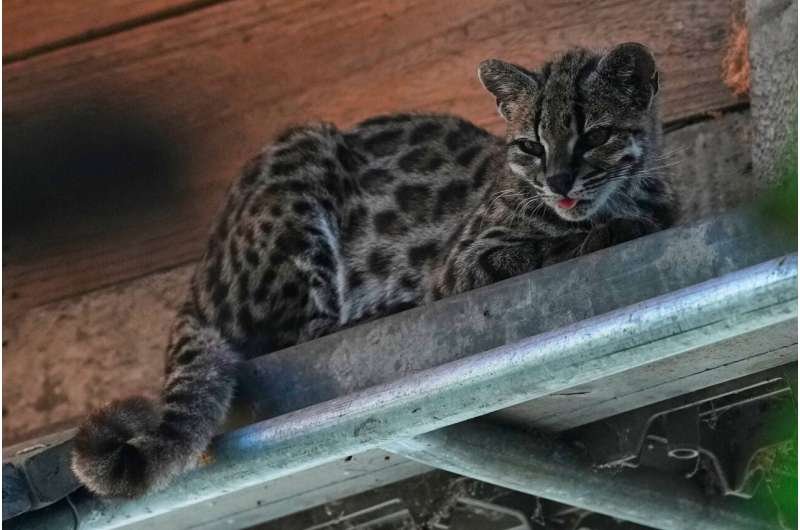
Tigrino is about 10 years old now and still lives at Senda Verde, in protective captivity. He cannot be released: he was raised by people during the most important months of his life, on a diet no wild cat should grow up on. He is easily stressed and is kept away from public view, so if you visit the sanctuary, you will not see him. He is the only tilcayo in captivity, which is where one popular viral claim goes wrong: he is not “the last one left.” Camera traps in the Yungas have recorded wild tilcayos, and a second individual was sampled and released in 2018. There is a wild population out there. Scientists just do not know how big it is yet.
A quick warning for cat lovers scrolling social media: some of the “new cat” videos going around this month use AI-animated illustrations, not real footage. The real cat is cuter anyway.
A species at risk before we even knew it
The tilcayo has not yet been assessed by the IUCN as its own species. Tiger cats as a group are listed as Vulnerable and declining, and the research team has shared its findings ahead of a fresh five-species assessment. Co-lead Jonas Lescroart told Reuters the tilcayo “could potentially be considered endangered when assessed on their own.”
Its home, the humid cloud forests of the Bolivian Yungas on the eastern slope of the Andes, is under pressure from deforestation, farmland expansion, human-caused fires and mining. Wild tilcayos also face hunting when they go after poultry, and people keeping them as pets, the very thing that started Tigrino's story.
As senior author Eduardo Eizirik put it, these species “are at risk of disappearing before we even discover them.” The tilcayo got discovered in time. Now it needs the forest to stay standing.
Tilcayo fast facts
- Scientific name: Leopardus tilcayo
- Described: September 2026, Current Biology — first brand-new living cat species in over 100 years
- Size: 42.5–50.5 cm body, 25–26.5 cm tail, 1.5–2.0 kg
- Home: Bolivian Yungas cloud forest, confirmed only in Bolivia so far
- Diet: little known; small rodent remains found in scat; camera traps suggest it is nocturnal
- Family: one of five tiger cat species, alongside L. tigrinus, L. guttulus, L. pardinoides and L. emiliae
- Status: not yet IUCN-assessed as a separate species; may qualify as endangered
Sources: Lescroart et al., “Phylogenomics and museomics reveal five distinct species of tiger cats in South America,” Current Biology (2026); Reuters; Associated Press; Smithsonian Magazine; Science Friday; Sci.News. Real photos: Paola Nogales-Ascarrunz; AP Photo/Juan Karita.