Heads up: CrazyCatVid is reader supported. Some links below are affiliate links (Amazon, Litter-Robot, Life's Abundance). If you buy through them I earn a small commission at no extra cost to you. Every product here has been through my own four cats first.
Luna is a tortoiseshell. If you have ever lived with one, that sentence probably already made you nod.
She does 3am zoomies at full speed. She wants whatever she is specifically not allowed to have, and she wants it with an intensity that suggests a personal grudge. She will sit on my lap purring for six minutes and then bite my wrist for reasons she has never explained. My other three cats are, comparatively, extremely normal animals.
After a few years of this I finally went and read the actual science, because I wanted to know how much of “tortitude” is real and how much is people like me telling stories about our own cats. The genetics turned out to be far more interesting than I expected. The personality research turned out to be shakier than the internet claims. Here is both.
Why Tortoiseshell Cats Are Almost Always Female
The short version: the gene that makes a cat orange lives on the X chromosome.
Female cats have two X chromosomes. Male cats have one X and one Y. That single fact does all the work.
A female cat can carry the orange variant on one X and the non-orange variant on the other, which lets her express both colors at once. That is a tortie. A male cat has only one X, so he gets one instruction, and he comes out orange or he comes out black-based. He does not have a second X to argue with.
This is also why most orange cats are male, roughly 80 percent by the usual figures. A male needs only one copy of the orange variant. A female needs it on both X chromosomes to be fully orange, which is statistically less likely.
The Gene Was Only Identified in 2025
Here is the part that genuinely surprised me. Scientists have known orange was sex-linked in cats for over a century. They did not know which gene it was until last year.
In May 2025, two teams, one at Stanford and one at Kyushu University in Japan, published separately in the journal Current Biology and landed on the same answer. Orange coloration in domestic cats is associated with a roughly 5-kilobase deletion in an intron of the X-linked gene ARHGAP36. The deletion causes that gene to be expressed in pigment cells where it normally would not be, and that shunts the cell away from making dark pigment.
What makes it strange is that this is not how orange or red hair works in other mammals. In most species, red coloring traces back to the MC1R pathway. In cats it does not. Cats went and did something else entirely, which is on brand for cats.
So when I say Luna's coat is unusual, I mean it in a fairly literal scientific sense. The mechanism behind it was an open question until 2025.
X-Inactivation: Why the Patches Are Random
Knowing a female carries both variants explains why she can be two colors. It does not explain the patches. That takes a second mechanism.
Female mammals carry two X chromosomes but only need one working copy, so early in embryonic development each cell shuts one X down more or less at random. That cell then divides, and every descendant cell inherits the same choice. The result is a mosaic: patches of tissue where the paternal X is active, patches where the maternal X is active.
In a cat carrying orange on one X and non-orange on the other, this mosaic is visible on the outside. Every orange patch on Luna is a colony of cells descended from one embryonic cell that silenced the non-orange X. Every black patch is the reverse.
Two consequences worth knowing:
- No two torties can ever match. The pattern is generated by random events in an embryo, not inherited as a design. Even cloned cats do not reproduce the original's markings.
- You cannot breed for a specific tortie pattern. Breeders can select for tortoiseshell as a category. Nobody can order the swirls.
Luna has a patch of orange across her left eye that makes her look permanently unimpressed. That is a developmental accident from before she was born, and it is the single most accurate thing about her.
Tortoiseshell vs. Calico: The Actual Difference
People use these interchangeably and they are not interchangeable. The difference is white.
| Pattern | What you see | What is happening |
|---|---|---|
| Tortoiseshell | Orange and black marbled together, little or no white | Sex-linked orange plus X-inactivation, no significant white spotting |
| Calico | Distinct orange, black and white patches | Same as a tortie, plus a separate white spotting gene |
| Torbie | Tortie coloring with tabby striping inside the patches | Tortie plus an expressed tabby pattern |
| Dilute tortie | Cream and grey instead of orange and black | Tortie plus the dilution gene softening both pigments |
The white spotting gene is not on the X chromosome and has nothing to do with the orange system. It just covers areas with white and, as a side effect, pushes the remaining color into separate blocks instead of a marble. That is why calicos read as patchy and torties read as swirled.
Genetically, a calico is a tortie wearing a white apron.
Male Torties: Rare, and Usually Not Healthy
They exist. The commonly cited rate is about 1 in 3,000 tortoiseshell cats being male, and there are two main routes.
XXY (Klinefelter syndrome). This accounts for most of them. The cat has an extra X chromosome, so he has two X's to carry both color variants, and the tortie pattern shows up in a male body. Cats have served as an animal model for human Klinefelter syndrome in published research going back decades. Almost all XXY male cats are sterile, and testicular changes in these cats have been described as comparable to the human condition.
Chimerism. Rarer. Two embryos fuse early in development and the resulting animal carries two distinct cell populations. A chimeric male tortie can sometimes be fertile, depending on which tissues came from which embryo.
If somebody tries to sell you a male tortie as a rare valuable breeding animal, that is a red flag. He is almost certainly sterile, he may carry additional health considerations tied to the chromosomal arrangement, and he is not a breed. He is a genetic accident who deserves a good couch and a decent vet.
Is “Tortitude” Real? Honestly: Partly
This is where most tortie articles start overclaiming, so let me lay out exactly what the evidence is.
There is one study people always point to. In 2016, Elizabeth Stelow, Melissa Bain and Philip Kass at UC Davis published “The Relationship Between Coat Color and Aggressive Behaviors in the Domestic Cat” in the Journal of Applied Animal Welfare Science. They ran an internet survey of cat owners and analyzed about 1,274 completed responses. Owners rated how often their cat showed aggression toward humans in three contexts: everyday interaction, handling such as being picked up or brushed, and vet visits.
The finding: owners of sex-linked orange females, meaning tortoiseshells, calicos and torbies, along with owners of black-and-white and grey-and-white cats, reported aggression toward humans somewhat more often than owners of other colors.
Now the caveats, all of which matter:
- It is owner-reported, not observed by researchers. People who already believe in tortitude may notice and score it more readily.
- It is an internet survey, so the sample selects for people who are online and engaged enough to fill out a cat behavior questionnaire.
- The effect size was small. Individual personality accounted for far more variation than coat color did.
- It measures reported aggression in three narrow contexts, not “personality” generally.
- It has not been replicated by direct behavioral observation, and it remains contested.
Stelow herself made a point of saying the findings should not discourage anyone from adopting a tortie or calico, and noted she owns one.
So the honest answer is: there is one real study, it found a small effect in the direction tortie owners expect, and it is not strong enough to tell you anything about the specific cat in front of you. There is no established biological mechanism linking the ARHGAP36 deletion to temperament. Coat color genetics and behavior genetics are not the same system, and nobody has connected them.
My take, which is an opinion and not evidence: Luna is exactly the cat the stereotype describes. Also, one cat is not a study, and I know it. If I had adopted a calm tortie I would be writing a very different section right now.
Living With One
Whatever the research says, here is what has worked with Luna over the years.
- Give her a job. The bad behavior is nearly always unspent energy. Two real play sessions a day cut the 3am chaos by more than any product I have bought.
- Watch the overstimulation line. She gives clear warnings before she bites: tail flick, skin twitch, ears rotating back. The bite is not unpredictable, I was just not reading her.
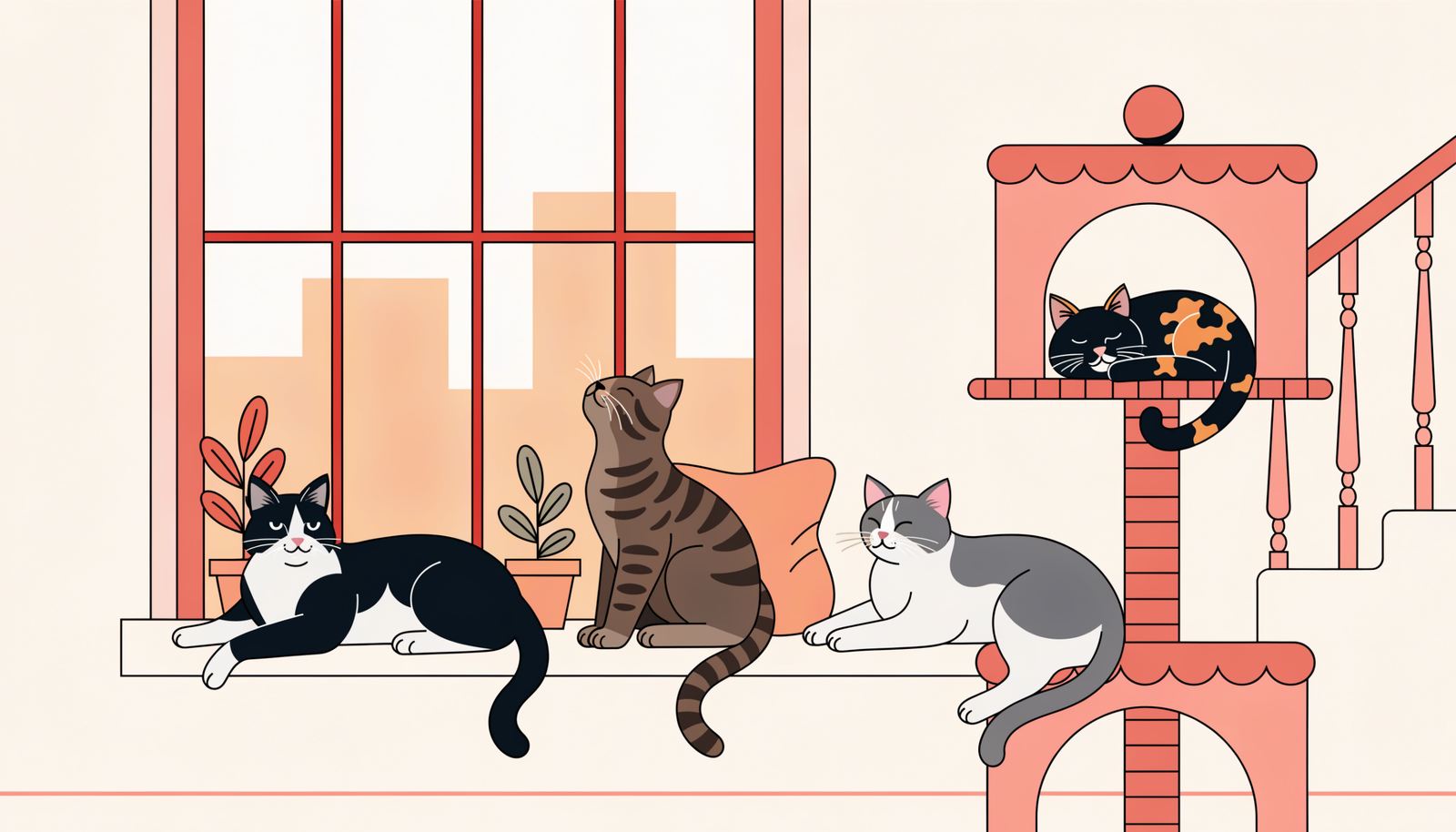
- Vertical space. She wants height and she wants to survey. A tall perch fixed more problems than a drawer of toys.
- Do not fight her over the forbidden thing. Attention is the reward. Making the thing boring works better than making it a contest.
If you want one specific recommendation, the thing that has held up best in my house is a decent tall cat tree. Luna uses the Yaheetech 63-inch cat tree as her personal watchtower, and the amount of trouble that has prevented is not small. Affiliate link, as always, and I bought mine.
The Short Version
Tortoiseshell cats are almost always female because orange is carried on the X chromosome. The patches come from random X-inactivation in the embryo, which is why no two are alike and why the pattern cannot be bred for. Calico is the same thing plus a separate white spotting gene. Male torties are usually XXY and usually sterile. And tortitude has exactly one survey behind it, showing a small owner-reported effect that nobody has confirmed with direct observation.
Luna, for her part, remains unbothered by any of this and is currently sitting in the one chair I need.
Watch it on YouTube
Tortoiseshell Cat and Tabby Playing: Luna vs Stripes
Feline Facts, product tests on camera, and the four cats being themselves.