Heads up: CrazyCatVid is reader supported. Some links below are affiliate links (Amazon, Litter-Robot, Life's Abundance). If you buy through them I earn a small commission at no extra cost to you. Every product here has been through my own four cats first.
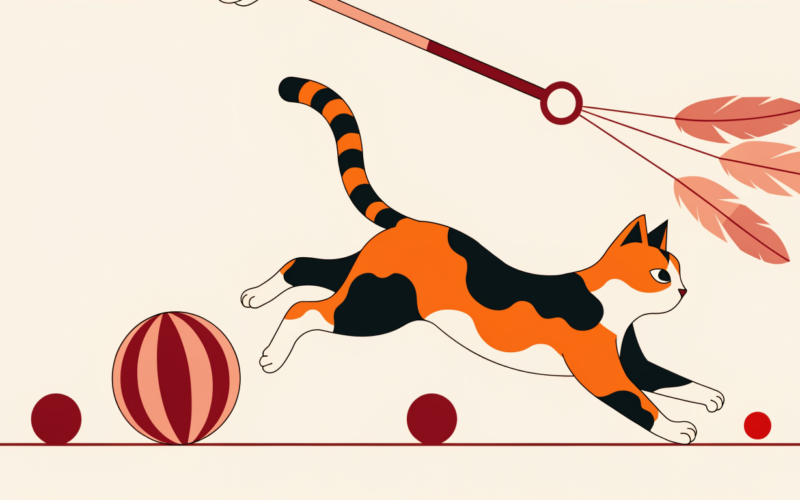
Luna has knocked my phone off the kitchen counter no fewer than 40 times. I'm not exaggerating for a blog post, I started counting in year one because I thought it was funny, and then I stopped counting because it stopped being funny and started being a screen protector budget.
She is a tortoiseshell, which means she was issued extra opinions at birth. But this isn't a Luna problem. Every cat does this. Mine do it in four distinct personal styles. So here's what's actually happening in their heads, according to people who study cats professionally rather than people like me who just live with a lot of them.
The short answer
There are three real explanations, and the annoying part is that they're usually all happening at once:
- It's hardwired hunting behavior, running with nothing to hunt.
- It's a physics experiment, and your cat is genuinely gathering data.
- It works. You react. Every single time.
1. The paw-tap is a hunting move
Watch a cat kill a bug sometime. They don't pounce and commit immediately. They reach out with one paw and tap it. Then they tap it again. Then they flip it, watch it, and only then decide whether to eat it or lose interest entirely and walk away like nothing happened.
That tap is a safety check baked into the predatory sequence. Is this thing alive? Does it bite back? Does it move when I move it? A cat's paw pads are packed with nerve endings and are one of their better tools for close-range information, partly because cats are actually pretty bad at focusing on objects a few inches from their face. Their eyes are built for spotting movement across a room, not for reading a pill bottle. So they use the paw.
Your pen on the desk is an unmoving object of unknown status. Tap. No response. Tap harder. Still nothing. Push it toward the edge, where it finally does something dramatic. From the cat's point of view, this is a completely reasonable investigation. From your point of view, it's a pen under the fridge for the next eleven months.
2. They're testing cause and effect on purpose
Cats are better at basic physical reasoning than most people give them credit for. Research out of Kyoto University found that cats use sound to make predictions about objects they can't see, expecting something to fall out of a container that rattles and reacting with surprise when the outcome breaks the rule. Cats notice when reality doesn't do what it's supposed to do.
Which reframes the whole counter thing. It isn't chaos. It's repetition with variables. Stripes doesn't just knock a glass over. He nudges it, watches, nudges it further, watches, then commits. He is, in the most literal sense, checking whether the same input produces the same output. It does. Every time. He seems satisfied by this and I have replaced four drinking glasses.
Cats also learn object permanence and track things they can no longer see, which is why the object hitting the floor and disappearing under the couch is interesting rather than confusing. There's a whole second phase of the game down there.
3. You are the reward, and you're extremely reliable
This is the one people don't want to hear. When your cat shoves a mug off the table, you look up. You say their name. You get out of your chair. You come over. Congratulations, you're trained.
Cats do not distinguish between good attention and bad attention nearly as cleanly as we do. Attention is attention. And because you don't react every single time, you've accidentally built the most powerful reinforcement schedule there is: intermittent. Slot machines run on this. It's the reason the behavior is so stubborn.
Minnie Mouse is the specialist here. She doesn't knock things over randomly. She does it while making direct eye contact with me. She waits until I'm looking, holds the pose, extends one paw, and pushes. That is not a hunting instinct. That is a cat with a functioning understanding of leverage over her roommate.
Why it's always 3am
Cats are crepuscular. They're wired to be most active around dawn and dusk, and a house cat with no hunting to do routes that energy somewhere. Luna runs at full speed into walls at 3am and I've just accepted this. The knocking-things-over stuff spikes at the exact same hours because it's the same surplus energy pointed at a smaller object.
Add the fact that you're asleep, so nothing is competing for the cat's attention, and a set of keys on a nightstand becomes the single most interesting item in the building.
When it's not just personality
Most of the time this is normal cat stuff. Occasionally it isn't. Pay attention if the behavior changes sharply rather than being a lifelong habit, especially alongside restlessness, weight loss, increased appetite, night vocalizing, or a senior cat who suddenly seems disoriented. Those can point to hyperthyroidism, pain, or cognitive changes in older cats.
I'm a guy with four cats and a spreadsheet, not a veterinarian. A sudden behavior change is a vet conversation, not a blog conversation.
What actually reduces it
You will not eliminate this. It's core cat firmware. You can turn the volume down considerably.
- Give the paw a better job. The instinct wants something that reacts when touched. A self-rolling ball or a puzzle feeder satisfies the same tap-and-see-what-happens loop. I keep a BABORUI interactive ball in rotation for about ten bucks, and honestly a cheap puzzle feeder does more for this than any toy I own, because it makes the cat work with their paws for something they actually want.
- Play hard before bed. Ten to fifteen minutes of real wand play, ending with a meal, moves a lot of the 3am energy earlier in the evening. This is the single highest-impact change I've made.
- Remove the audience. If you can manage it without a scene, don't react. Pick the thing up later, silently. Boring is the punishment cats actually feel.
- Stop leaving prey on the table. Pens, earbuds, chapstick, hair ties, small round things near an edge. That's a loaded counter. I moved my phone charging station away from the edge and the incident rate dropped noticeably.
- Museum putty on the stuff that matters. Not glamorous. Three dollars. Ends the argument for anything you can't move.
What doesn't work
Spray bottles. Yelling. Any form of punishment. Cats don't connect a consequence to an action the way we want them to, so all you're teaching is that you are occasionally unpredictable and unpleasant. That damages the relationship and does nothing to the behavior. Penelope has an entire YouTube audience and cannot be intimidated by a spray bottle. Neither can yours.
The honest conclusion
Your cat is a small predator with excellent paws, a real curiosity about how objects behave, and a working theory that you'll get up if something hits the floor. All three of those are true at once, and none of them are things you can talk them out of.
Luna is going to knock my phone off the counter again this week. I've made peace with it. I just bought a better case.